October 22, 2026 · Money & Soulism
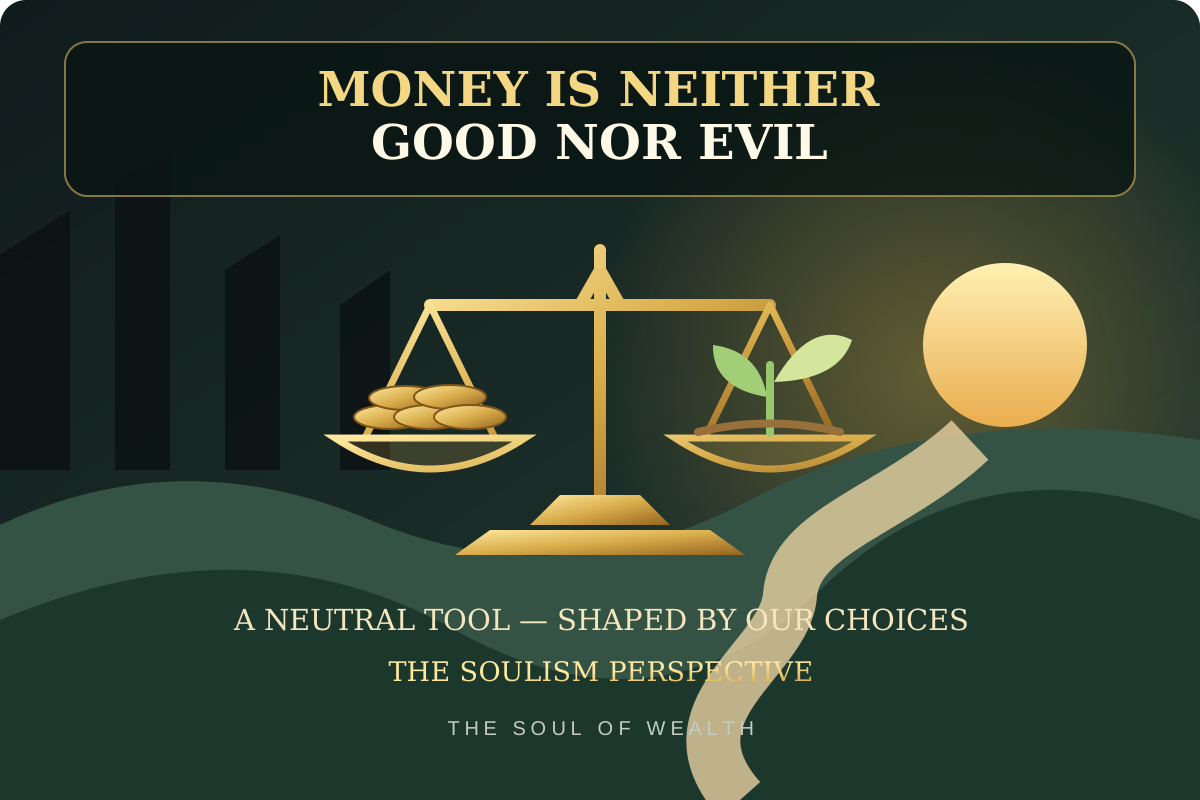
Money Is Neither Good Nor Evil: How We Earn, Use, and Value It
Money shapes many parts of modern life. It can help us provide for our families, access education and healthcare, prepare for uncertainty, and gain more freedom over our choices. Yet money also carries emotional weight: people may feel guilty for wanting it, ashamed of not having enough, or convinced that wealth defines their worth.
What if money itself is neither good nor evil?
From the perspective of Soulism, money is a tool—not a moral identity. Its consequences depend on how it is earned, how it is used, and the place it occupies in our lives.
Money is a tool, not a character test
Money can fund a child’s education, help a family through a crisis, support useful work, or give someone the freedom to leave an unsafe situation. It can also be used for manipulation, exploitation, or vanity.
The amount alone does not tell us which is happening. We need to consider the methods used to earn it, the decisions made with it, and the effects those decisions have on other people.
This does not mean every financial action is morally neutral. Fraud and exploitation can cause real harm. Rather, it means we should judge actions by their honesty, consequences, and ethics—not assume that money itself makes a person good or bad.
Why do we feel guilty about money?
Our beliefs about wealth often come from family, culture, social expectations, and the stories we hear about success. We may learn that wanting more money is selfish, that rich people are necessarily greedy, or that people with less money are somehow more virtuous.
These assumptions can distort our decisions. Someone may feel guilty for asking for fair pay, learning to invest, or trying to improve their family’s financial stability. Someone else may feel inferior because they earn less than their friends.
But income is not a complete measure of character. Financial circumstances are shaped by opportunities, responsibilities, health, economic conditions, and many other factors. Your bank balance describes a financial situation; it does not describe the full value of your life.
Wealth without awareness can become a trap
Money can begin as a means to security and gradually become the main measure of success. One milestone leads to another; lifestyle expectations rise; comparison becomes exhausting. A person can keep accumulating while feeling that they never have enough.
Ambition is not the problem. Building wealth can be responsible and worthwhile. The question is whether the pursuit of money supports the life you value—or steadily replaces it.
Pause and ask yourself:
- Am I earning money to support my life, or sacrificing every part of life to earn it?
- Do my financial goals reflect my values or other people’s expectations?
- Does my spending serve genuine priorities, or mostly comparison and impulse?
- What would “enough” look like for my own circumstances?
Awareness makes it easier to choose financial goals deliberately rather than follow every external definition of success.
Poverty is not proof of virtue; wealth is not proof of wisdom
Neither wealth nor poverty tells the whole story of a human being. A person with money can be generous or exploitative; someone with limited means can be kind or unkind. We should not romanticise hardship, nor treat financial success as automatic evidence of wisdom.
Financial stability matters. It can reduce avoidable stress, improve access to essential services, and give people more choices. Wanting to improve your financial position is not a moral failure.
The point is not to worship wealth or condemn it. It is to understand its place in a balanced life—and to make ethical choices whatever our circumstances.
The Soulism approach: awareness before attachment
Soulism encourages conscious living rather than blindly accepting social expectations or inherited assumptions. Its guiding principle, “Awareness is the Highest Authority,” invites us to examine our beliefs, choices, and the consequences of our actions.
Applied to money, awareness means asking why we want it, recognising emotions that influence our decisions, examining the evidence behind financial claims, and taking responsibility for our choices.
A conscious relationship with money can include earning honestly, spending intentionally, saving for uncertainty, understanding investment risks, giving when we can, and defining what financial security means to us. None of these practices guarantees wealth, but they can help bring our financial decisions closer to our values.
Wealth should expand life, not replace it
Money can buy a comfortable home, but it cannot guarantee a loving family. It can create opportunities, but it cannot decide which opportunities matter. It can purchase entertainment, but it cannot promise lasting fulfilment.
Financial prosperity and inner prosperity do not have to compete. Financial prosperity is about resources, security, and choice. Inner prosperity is about awareness, relationships, values, and how deliberately we live.
A healthy approach makes room for both: work toward financial freedom without allowing wealth to become the only measure of success.
A book to explore: The Soul of Wealth
These ideas connect with my book, The Soul of Wealth: The Soulism Way to Money, Freedom, and Inner Prosperity. The book explores the relationship between money and the broader experience of living well, considering wealth not merely as possessions or a number, but in relation to freedom, awareness, personal values, and inner fulfilment.
Its central theme is that money can have a meaningful place in life without becoming the only measure of success. For readers interested in reflecting more deeply on their relationship with wealth, the book offers a way to explore these questions through the wider perspective of Soulism.
Conclusion: let money serve your life
You do not need to feel guilty simply for wanting security. You do not need to feel superior because you have accumulated wealth. And you do not need to measure your worth against someone else’s income.
Earn responsibly. Spend consciously. Plan for the future. Question the beliefs that shape your financial decisions.
Money is a resource. Awareness gives direction to its use. Your values help determine the life you build with it.
Perhaps financial freedom begins not when we stop caring about money, but when we stop allowing money to define who we are.
Explore the book: The Soul of Wealth: The Soulism Way to Money, Freedom, and Inner Prosperity
Visit The Soulism