August 08, 2026 · Belief
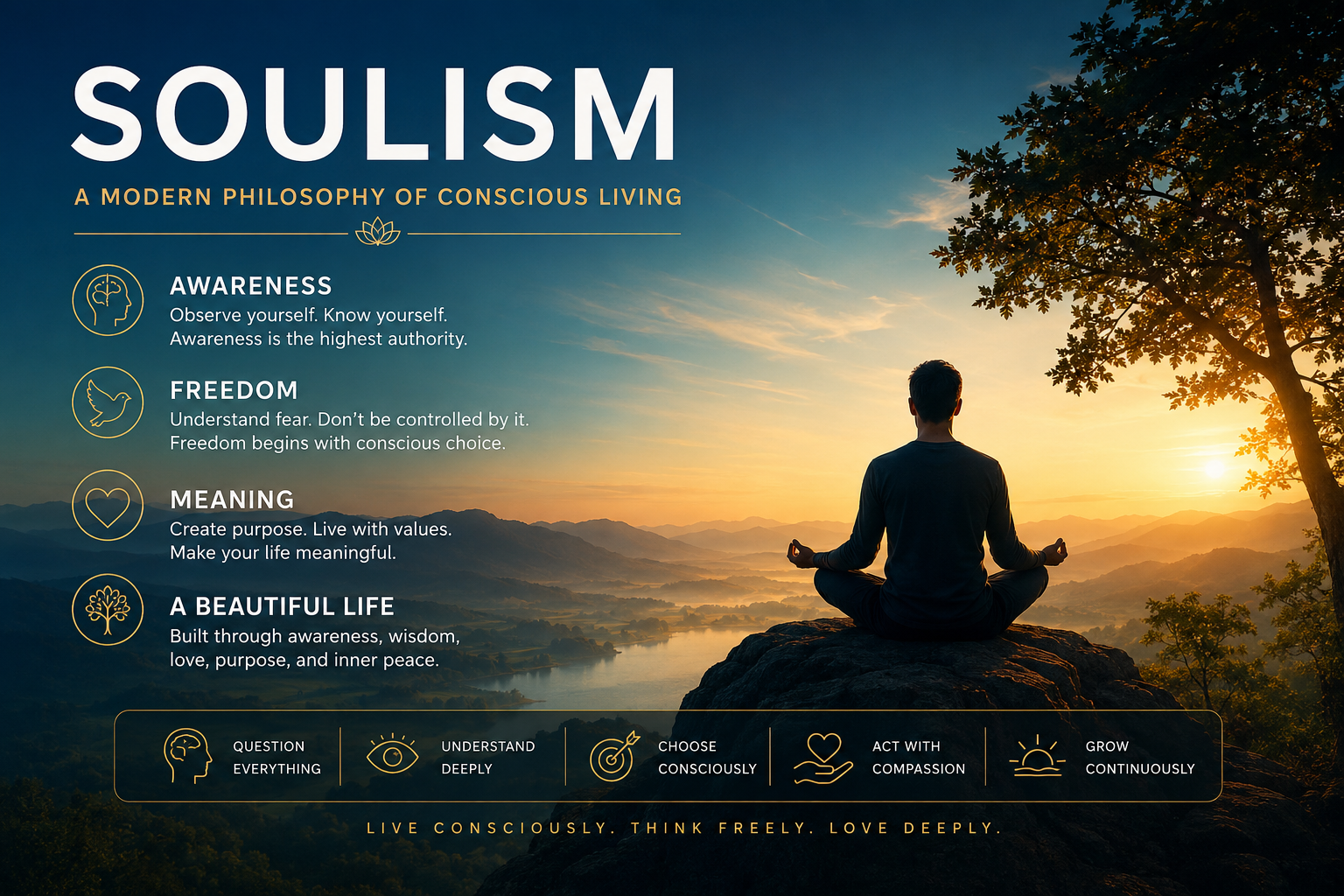
Soulism is a modern, experience-based philosophy that places conscious awareness at the center of human life.
It does not ask you what to believe. It asks you to become aware.
It does not ask you to escape life. It asks you to understand life.
What Is Soulism?
Soulism teaches that a beautiful life is not created simply by improving external circumstances. It is created by improving the quality of our awareness.
A conscious life is a better life.
When we become aware of our thoughts, emotions, fears, beliefs, desires, choices, and actions, we gain the ability to respond to life rather than merely react to it.
The Meaning of "Soul"
The word Soul has traditionally been associated with religion and the supernatural.
Soulism uses the word differently.
Within Soulism, the Soul is Conscious Awareness.
It is the part of human experience capable of observing, questioning, reflecting, understanding, choosing, and growing.
"The Soul is not something you are asked to worship. It is something you are invited to awaken."
Soulism Is Not a Religion
Soulism does not require a God, religious rituals, sacred ceremonies, a particular scripture, or unquestioned beliefs.
It also does not require you to reject your existing religion or cultural traditions.
A person may be religious and explore Soulism. A person may be nonreligious and explore Soulism. A person may be uncertain about religion and explore Soulism.
The essential requirement is not belief. It is awareness.
The Central Principle of Soulism
At the center of Soulism is the relationship between Awareness and Fear.
Fear is a natural part of human life. We fear failure, rejection, uncertainty, loss, loneliness, judgment, and death.
Fear itself is not the enemy. The problem begins when fear becomes the primary force controlling our decisions.
"Increase awareness until fear no longer controls your life."
The Soulism Balance
Soulism describes human life through the relationship between Awareness and Fear.
Awareness — Observation, clarity, reflection, conscious choice, understanding, and responsibility.
Fear — Uncertainty, insecurity, rejection, failure, loss, comparison, and the instinct to protect ourselves.
The goal is not to create a human being who never feels fear. The goal is to develop the awareness necessary to recognize fear without automatically obeying it.
Happiness According to Soulism
Soulism distinguishes between Pleasure and Happiness.
Pleasure can come from food, entertainment, shopping, money, praise, achievement, and comfort.
Pleasure is not bad. It is a natural part of life. But pleasure is temporary.
Deeper happiness develops through conscious living, inner alignment, meaningful relationships, growth, and reduced domination by fear.
"Pleasure can make a moment enjoyable. Awareness can make a life meaningful."
Freedom According to Soulism
Freedom is more than the ability to do whatever you want.
A person can have unlimited choices and still be controlled by fear, addiction, social pressure, comparison, anger, or insecurity.
Who is making your choices?
Inner freedom is the growing ability to choose consciously rather than automatically.
Love and Relationships
Soulism does not view love as ownership.
Healthy love respects another person's humanity, dignity, freedom, and growth.
Love Requires — Honesty, respect, empathy, boundaries, freedom, responsibility, and emotional awareness.
Conscious Relationships — The goal is not to eliminate attachment completely, but to understand attachment so deeply that love does not become control.
Success According to Soulism
Soulism does not reject money, ambition, achievement, or material success.
It simply refuses to make them the complete definition of a successful life.
Achievement + Awareness + Relationships + Growth + Purpose + Inner Peace
External success matters. But how you experience your success matters too.
Meaning and Purpose
Soulism does not require every human being to discover one predetermined purpose.
It encourages people to consciously create meaningful lives through relationships, learning, creativity, contribution, growth, meaningful work, and personal values.
"Meaning is something we participate in creating."
Wisdom
Knowledge tells you what something is. Wisdom helps you understand what to do with that knowledge.
Soulism views wisdom as the ability to combine awareness, experience, reflection, reason, compassion, and responsibility.
Morality
Soulism does not reduce morality to obedience.
A conscious moral life requires understanding how our actions affect other conscious beings.
- What am I doing?
- Why am I doing it?
- Who might be affected?
- Am I acting consciously or reactively?
Growth
Soulism does not define growth as becoming perfect.
Human growth is not a straight line. We learn, improve, struggle, make mistakes, become aware, and continue growing.
"You do not have to become perfect. You have to become more conscious."
The Soulism Way
Soulism becomes meaningful when philosophy becomes practice.
- PAUSE — Do not react immediately.
- OBSERVE — Notice what you are thinking and feeling.
- QUESTION — Ask what is driving your reaction.
- UNDERSTAND — Look beneath the surface.
- CHOOSE — Decide consciously.
- ACT — Take responsibility for your action.
- REFLECT — Learn from the result.
- GROW — Use the experience to become more aware.
The 15 Principles of Soulism
Soulism is not intended to remain theoretical. Its principles provide a practical foundation for conscious living.
- Awareness as the highest authority.
- Truth through conscious experience and inquiry.
- Freedom of thought.
- Questioning before acceptance.
- Conscious presence.
- Compassion over fear.
- Morality through awareness and responsibility.
- Respect for conscious life.
- Responsibility toward nature.
- Personal responsibility.
- Lifelong learning.
- Simplicity and clarity.
- Honest self-reflection.
- Creating meaningful purpose.
- Building a beautiful life through awareness, wisdom, love, and peace.
The Vision of Soulism
Soulism imagines a future in which human progress is measured not only by how much we produce, but also by how consciously we live.
Education — Teaching awareness alongside knowledge.
Relationships — Building relationships based on understanding and respect.
Leadership — Combining power with wisdom and responsibility.
Human Progress — Measuring progress not only through achievement, but through conscious living.
The Soulism Statement
Awareness is the highest authority.
Fear should be understood, not blindly obeyed.
Truth should be explored, not merely inherited.
Freedom begins with conscious choice.
Meaning is created through conscious living.
Growth is a lifelong journey.
And a beautiful life is built through awareness,
wisdom, love, purpose, and inner freedom.
Welcome to Soulism
You do not have to believe everything you read here.
Read. Question. Observe. Reflect. Experience.
Soulism begins with a simple invitation:
Wake Up to Your Own Awareness.
Live consciously.
Think freely.
Love deeply.
Grow continuously.
Create a Beautiful Life.